The Invisible Energy Giant: Primary Lithium Batteries Explained
The Invisible Energy Giant: Primary Lithium Batteries from Basic Principles to Industrial Applications
They power pacemakers for a decade, mark deep-sea detectors, and silently meter smart utilities — yet they never get recharged. Meet the primary lithium battery: the ultimate reliable workhorse.
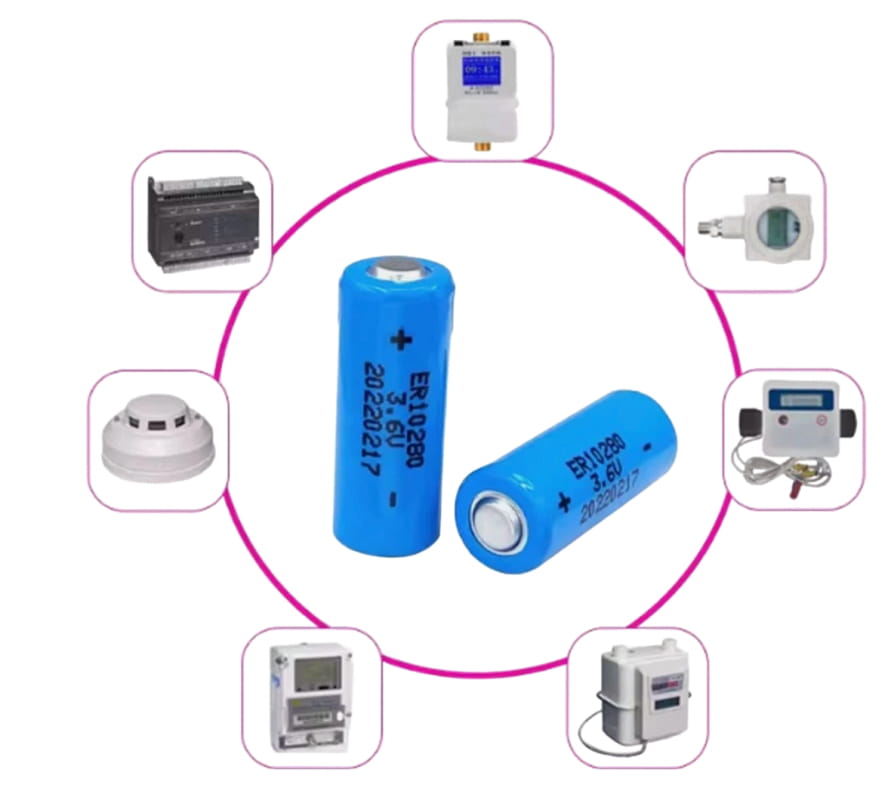
1. What is a Primary Lithium Battery? How is it Different from Your Phone Battery?
A primary lithium battery is, simply put, a non‑rechargeable lithium battery. Its core is metallic lithium — the lightest metal on the periodic table, with a density of only 0.534 g/cm³.
-
Anode (–): Metallic lithium (highly reactive, must be kept away from water).
-
Electrolyte: Non‑aqueous (lithium salts dissolved in organic solvents; water would cause violent reaction).
-
Cathode (+): Metal oxides or other solid/liquid oxidizers, chosen according to application.
Today, the two most important families are Lithium‑Manganese Dioxide (Li/MnO₂) and the high‑energy champion Lithium‑Thionyl Chloride (Li/SOCl₂).
2. The Performance King: Lithium‑Thionyl Chloride (Li/SOCl₂) Battery
If the battery world had special forces, it would be Li/SOCl₂. Its ingenious design — thionyl chloride (SOCl₂) acts as both solvent and cathode active material — creates unmatched characteristics.
Core advantages: built for extremes
-
Peak energy density – up to 420 Wh/kg (650 Wh/kg at low rate), the highest among primary batteries.
-
"Horizon‑flat" discharge – voltage stays near 3.3V for 90% of capacity; perfect for precision instruments.
-
Extreme temperature range – operates from –40 °C to +150 °C. Arctic cold or desert heat, it delivers.
-
Decade‑plus shelf life – extremely low self‑discharge; install it and forget the battery.
Acknowledged shortcomings — Voltage delay after long storage (needs circuit compensation) and inherent safety sensitivity if misused (short circuit / reverse charging). Production requires strict atmosphere control.
3. The Popular Choice: Lithium‑Manganese Dioxide (Li/MnO₂) Battery
If Li/SOCl₂ is an industrial titan, the Li/MnO₂ cell is your everyday helper — you’ve almost certainly seen the CR2032 coin cell on computer motherboards. Simpler, safer, and more affordable.
-
Consumer electronics – motherboard CMOS, watches, calculators, remote controls.
-
Memory backup – BIOS, PLCs, S‑RAM, electronic metering.
-
Small medical/industrial – thermometers, compact sensors.
4. Application Panorama: From Deep Sea to Space, Human Body to Power Grid
Primary lithium batteries shine where high reliability and maintenance‑free operation are non‑negotiable.
-
Medical: Pacemakers, insulin pumps, AEDs. A ten‑year promise of energy.
-
Industrial & IoT: Smart meters (water, gas, electricity), pipeline inspection gauges, downhole tools – the invisible accountant.
-
Military & Aerospace: Soldier radios, underwater drones, satellites. Where no one can come to recharge.
-
Industrial control – RFID, wireless sensors, security equipment.
-
Instrumentation – seismic recorders, earthquake detectors, data loggers.
-
Consumer memory – backup power in cameras, electronic meters.
5. Core Raw Material: Lithium Metal – The "White Oil" of Modern Industry
All these remarkable performances are built upon metallic lithium. This silvery‑white, ultra‑light metal (melting point 180.5 °C) is produced industrially via molten salt electrolysis:
-
Electrolysis – LiCl with KCl flux in electrolytic cells yields crude lithium ingots.
-
Purification – Vacuum distillation upgrades to battery‑grade (high purity).
-
Processing – Rolled into lithium strips, foils, or granules for battery assembly.
6. Future Outlook: The Silent Energy Revolution Continues
While the world chases rechargeable chemistries, primary lithium keeps advancing in its own quiet way:
-
Higher energy density – new cathode materials pushing limits.
-
Smart batteries – integrated with status self‑diagnosis.
-
Greener & recyclable – sustainable materials and recovery processes.


